

The Wash Day Series: Part 9 ~ Trimming & Length Retention: Why Holding onto Every Inch Isn't Always the Answer
One of the hardest conversations I have with clients is about trimming their hair. Almost every time, I hear the same thing: “I don’t want to lose my length.” I completely understand. When you’ve spent months—or even years—growing your hair, the thought of cutting it can feel like taking a step backwards. But here’s what I want you to consider: Sometimes, holding onto every inch is the very thing keeping you from achieving the healthy, long hair you’re working so hard for.
Length and healthy hair are not always the same thing.
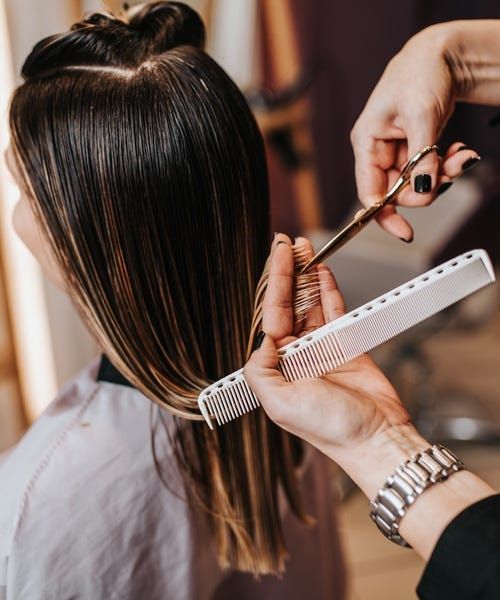
Growth and Length Retention Are Two Different Things
One of the biggest keys to retaining length isn’t avoiding trims—it’s understanding when your hair actually needs one. Let’s clear up one of the biggest misconceptions in hair care. Your hair grows from the scalp. It does not grow from the ends. The ends simply represent your oldest hair. So, when we talk about growing longer hair, what we’re really talking about is retaining the hair that’s already grown. Does that make the concept crystal clear? The light bulb turned on for me with that one!
If the ends continue to split and break off at the same rate your hair is growing, it can feel like your hair has stopped growing altogether. It hasn’t. You’re just losing length as quickly as you’re gaining it. That’s why healthy ends matter so much.
Split Ends Don’t Repair Themselves
This is probably one of the biggest myths in hair care. Once a strand splits…It stays split. No oil. No serum. No miracle treatment. No expensive product can permanently fuse a split end back together. Some products can temporarily smooth the appearance of split ends, making the hair look healthier for a short time. But eventually, that split continues traveling farther up the hair shaft.
The longer it’s left untreated, the more damage it can create. That’s why trims are preventative—not punishment!
Why Hanging Onto Damaged Ends Can Cost You More Length
Imagine a rope. If the end begins to unravel and you ignore it, eventually the fraying works its way farther up the rope. Hair behaves similarly. Split ends don’t simply stay at the bottom forever. As they continue splitting, more of the strand becomes weakened. Eventually, what could have been a small trim becomes a much-needed haircut. Ironically, refusing to trim often results in having to remove more hair later.
Shedding vs. Breakage: Know the Difference
Many people use these terms interchangeably, but they’re very different.
Shedding
Shedding is completely normal. Each hair grows through a natural cycle before eventually shedding from the follicle. A shed hair typically has a small white bulb attached to one end. Finding these hairs in your brush, sink, or shower is expected.
Breakage
Breakage happens when the hair strand snaps before completing its natural life cycle. Broken hairs are often shorter, uneven in length, and usually don’t have that white bulb attached.
Breakage can result from:
- Excessive heat
- Chemical damage
- Tight hairstyles
- Dryness ~ aka the silent killer ~ this will take your length ouuuut!
- Poor detangling
- Split ends left untreated
Understanding the difference helps you identify whether your hair care routine needs adjustment—or whether what you’re seeing is simply part of your hair’s normal growth cycle.
How Often Should You Trim?
This is a very popular question. The honest answer? There isn’t a one-size-fits-all schedule. It varies for your hair type, chemical treatment schedules, protective style schedules, rate of growth and the overall wear and tear of your tresses.
Other factors that can contribute to determining when you may need a trim are:
- Your hair’s present condition
- Heat usage
- Your styling habits
- Environmental exposure
- Your overall hair goals
Instead of trimming according to the calendar, learn to recognize when your hair is asking for one.
For an estimated answer, Naturalistas that tend to stay curly, I recommend every three to four months, but based on the need. Curly ends often tell the story faster than straight ends because of the wear and tear but, they are more difficult for the untrained eye to detect. You usually don’t notice until they are way beyond needing the trim, as the curl itself can actually camouflage what state the ends are really in.
For my relaxed clients , I often suggest that they get a trim after every relaxer service. Indulge in the complete overhaul, the relaxer, deep treatment and trim. This keeps them on a cycle, allows them to see their length retention as they meet their goals, and to take off the minimal amount, unless the wear and tear for whatever reason during that particular cycle was not normal (due to life, pregnancy, neglect, protective styling, overuse of heat, stress, hormonal changes, medication etc).
Silk Presses are always the time for a trim/cut/dust. A silk press will not fall properly if there are split or frayed ends. It ruins the whole process. My silk press service automatically includes a trim/cut/dust to ensure a successful final outcome.
If a client is coming in to prep their hair before braiding , I will also take the opportunity, as I “blow them out for braids,” to trim them after it is aired out for braiding. this allows the curly hair to be stretched allowing you to see what ends need to be trimmed easier. It is always good to trim after a protective style, but if you are in need of one, have not done one in a while; this is also a good time to make it happen!
Signs Your Hair May Need a Trim
Your hair may be telling you it’s time if you notice:
- Split or frayed ends
- Single-strand knots (common in curly hair)
- Increased tangling at the ends
- More breakage than usual
- Thin, wispy, see-through ends ~ there is nooooo questioning if…it is a matter of when!
- Styles that no longer hold their shape
- Rough or dry ends that don’t improve after moisturizing
One sign alone doesn’t necessarily mean you need a trim immediately. But if you’re noticing several of these consistently, it may be time to evaluate your ends, or have your stylist take a look.
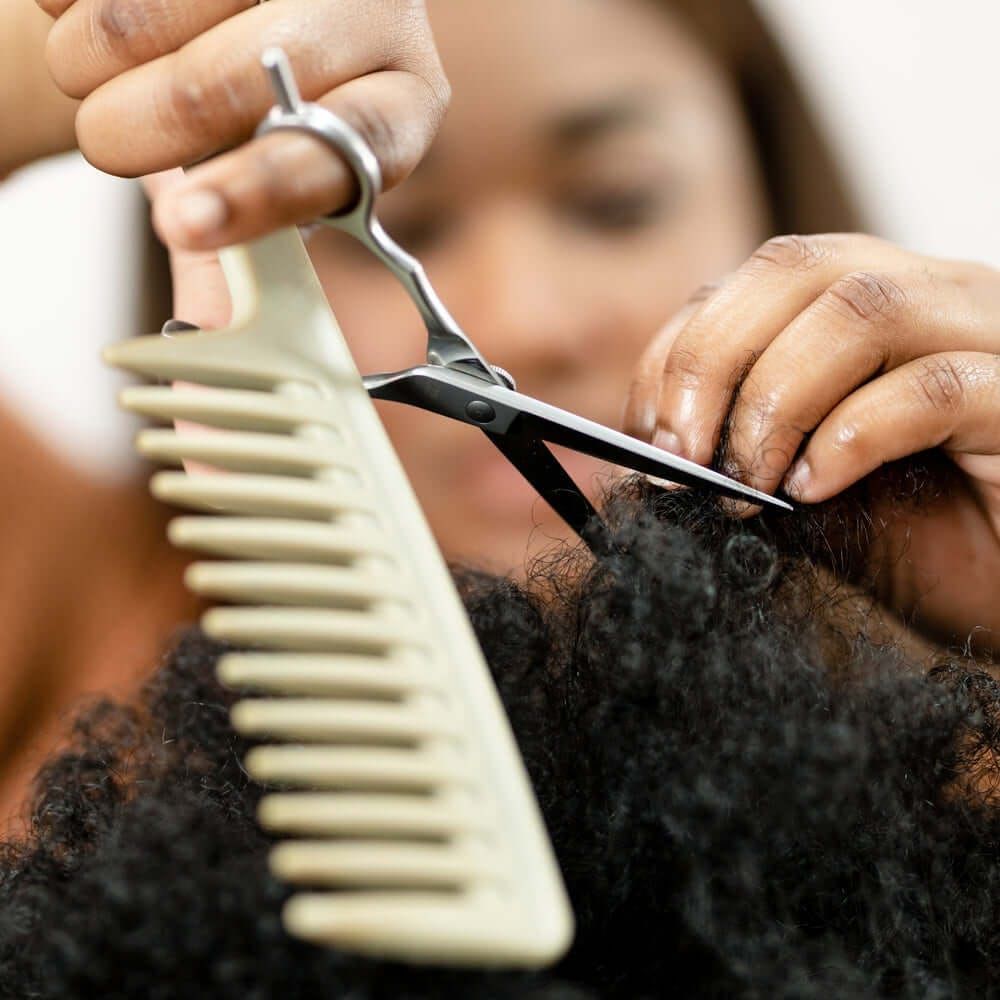
Every Trim Doesn’t Have to Be a Big Chop
One reason people avoid trims is fear . They picture inches falling to the floor. But maintenance trims are often exactly that—maintenance. Sometimes only a small amount needs to be removed to keep the ends healthy and prevent further splitting. The goal isn’t to cut your hair short. The goal is to preserve the health of the hair you’ve worked so hard to grow. Not getting those needed trims on time can be counterproductive to the very goal that you are working towards.
I do give my clients the option when we assess the hair during the trim portion of the appointment. I am very transparent with them during this process. I show them in the mirror the maximum amount that needs to be taken off for their hair to be at it’s fullest and healthiest. I also show them the minimum amount that we can take off for their hair to perform the way it needs to, with the agreement that we WILL continue this series of trims routinely until we arrive at the goal of the fullest and healthiest hair that they can have. Not everyone is comfortable with shorter hair and prefer to not lose all of their length but to get there in stages. We meet in the middle, agree on a length and I trim/cut the perimeter while they are holding the mirror and can see that as a result, their hair already looks better perimeter post trim. That builds trust in me as their stylist and in the process, if they continue to trust and commit, they will achieve the hair goals that we have set.
To See or Not to See
As a personal rule, before I was a Stylist (and was another Stylist’s client) and now as a Stylist; I do not trust anyone who turns me away from the mirror. Unless our agreement is a hidden transformation, revealed at the end. There is no reason why the client should not be a participant and their service be a transparent process.
It is a scary process for many, and if they are not allowed to sometimes interject or ask questions, even with a thorough consultation what they thought they wanted may not end up being what they want. Also, it allows you as the stylist to explain technically again why they may or may not be able to achieve certain things based on where their hair is. Stylists take for granted that clients truly understand what you explain to them. What is common knowledge for you can be a foreign language for them, and they are often afraid .
This also circumvents, those Stylists who may have been out of their depth with a client’s requests or a rogue Stylist who despite what you asked for just wants to do their own thing. If you can see what is happening, you can partake in the process perhaps, before it goes contrary to what was discussed and agreed upon.
Trust and transparency should always be the foundation on which your Stylist-Client relationship is built, otherwise……what are we doing?
Healthy Ends Make Styling Easier
Healthy ends don’t just look better. They behave better. They detangle more easily. They hold styles more consistently. They create smoother ponytails, fuller curls, cleaner blowouts, and neater braid-outs. Even if your hair is long, damaged ends can make it appear thinner, frizzier, and less polished.
Healthy ends give your entire hairstyle a stronger foundation.
Caring for Your Ends Between Trims
A trim is only part of the equation. Keeping your ends healthy between appointments is what helps you retain length over time.
That means:
- Moisturizing when needed
- Protecting your hair while you sleep
- Limiting unnecessary heat
- Being gentle during detangling
- Avoiding excessive tension
- Wearing low-manipulation or protective styles when appropriate
- Keeping up with regular wash days
Healthy habits reduce the amount of damage your ends experience in the first place.
It’s About Progress, Not Perfection
There isn’t a finite trimming schedule. Hair care is personal. Your routine should be based on where your hair is at any given moment—not simply what is trending or what works for someone else.
The more familiar you become with your hair, the easier it becomes to recognize when your ends need attention. Your Stylist is always available to confirm your thoughts and execute on your behalf if you care for your hair at home most of the time. Those who are in the salon regularly, your Stylist should have you on a regular maintenance trimming schedule if you both have set length retention goals that you want to achieve. Be patient and consistent……. you WILL get there!
I Leave You With…
Healthy hair isn’t measured by how long it is. It’s measured by its overall condition. Sometimes that means trimming a little today, so you don’t have to cut a lot tomorrow. Remember, your goal isn’t simply to grow hair. Surely, you know that having long ends….IS NOT HAIR! Your goal is to retain healthy hair. Healthy ends are one of the biggest contributors to long-term length retention.
Sometimes letting go of a little allows you to keep so much more…..don’t be afraid. What you really want is actually waiting for you!